
The signs of high-functioning trauma are the quiet ways your nervous system stays braced for danger while your life looks successful from the outside. Your calendar is under control, your work gets praised, and people call you the steady one. Still, part of you is waiting for the other shoe to drop.
If that sounds familiar, you're not broken. You also don't need to be in crisis for this to matter. Below, you'll find the emotional, behavioral, physical, and relationship patterns many women notice, plus a gentle self-check and a look at what support can be like here in Raleigh, NC.
What Does High-Functioning Through Trauma Mean?
High-functioning trauma describes keeping up with work, family, and goals while carrying unresolved trauma responses underneath. On the outside, you're capable and reliable. On the inside, your body may still be in survival mode, staying on guard as if the danger never passed. It's a description of patterns, not a formal diagnosis.
It's easy to miss because it gets praised. Productivity, calm, and reliability look like success, so few people ask what they cost you. Trauma itself is common. The National Center for PTSD reports that at least half of Americans have been through a traumatic event. Many of those people carry the effects quietly and look like they're doing fine.
Emotional Signs: Worry Hidden Beneath Keeping Up
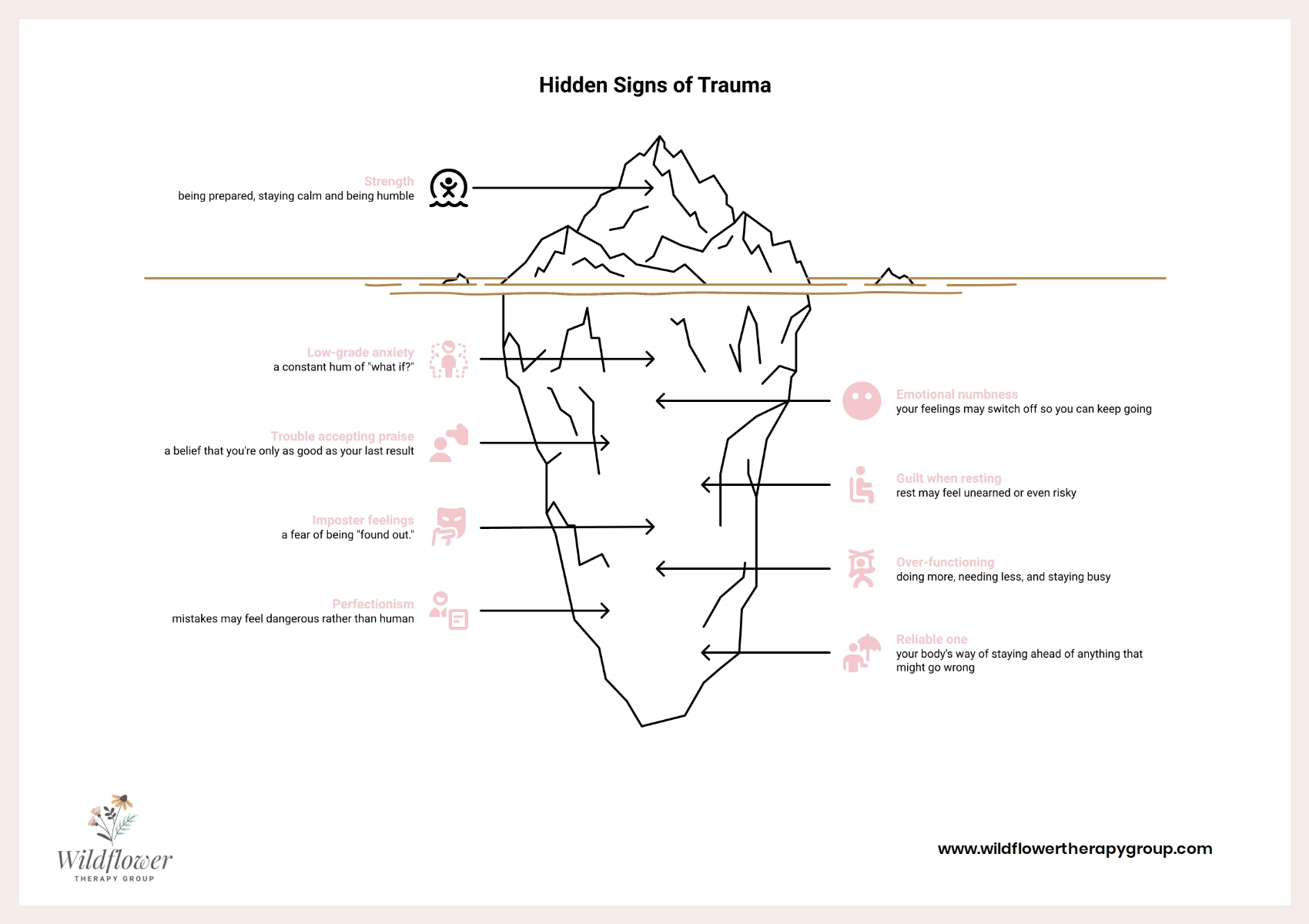
Emotionally, high-functioning trauma often hides behind what looks like strength: being prepared, staying calm and being humble. Underneath, these behaviors may reflect ways your nervous system learned to keep you safe.
Low-grade anxiety looks like being prepared. Underneath, there can be a constant hum of "what if?"
Emotional numbness looks like staying calm in a crisis. Underneath, your feelings may switch off so you can keep going.
Trouble accepting praise looks like humility. Underneath, there may be a belief that you're only as good as your last result.
Guilt when resting looks like a strong work ethic. Underneath, rest may feel unearned or even risky.
Imposter feelings look like high standards. Underneath, there can be a fear of being "found out."
Staying calm under pressure doesn't prove that nothing happened. Sometimes it's a trauma response doing exactly what it learned to do.
Behavioral Signs: Perfectionism, Overworking, and Being the Reliable One
The behavioral signs often look like over-functioning: doing more, needing less, and staying busy. These are coping mechanisms, not character flaws.
Perfectionism looks like excellence. Underneath, mistakes may feel dangerous rather than human.
Being the reliable one looks like dependability. Underneath, it can be your body's way of staying ahead of anything that might go wrong.
People-pleasing looks like kindness. Underneath, keeping others happy may feel like keeping yourself safe. If this one hits home, read more about fawning and people-pleasing.
Never asking for help looks like independence. Underneath, needing someone may once have felt unsafe.
Staying busy looks like productivity. Underneath, it can be a quiet form of avoidance, since slowing down brings up feelings you've been outrunning.
How It Shows Up at Work
Many high achievers swing between pushing hard and burning out. You may find boundaries nearly impossible to hold, or replay a small typo for days. These patterns may have helped you feel safe at one point. They're smart survival strategies that may simply be working overtime now.
Can overthinking be a trauma response?
Yes. After trauma, the mind can stay on guard by replaying events, scanning for what could go wrong, and rehearsing worst-case scenarios. This kind of overthinking is an attempt to feel safe and in control. It often goes unnoticed in people who function well on the outside. Therapy can help your mind and body learn that the danger has passed.
Hypervigilance That Feels Normal (and Why Calm Can Feel Unsafe)
Hypervigilance involves constantly scanning for possible threats, even when there's no immediate danger. It happens so automatically that many people don't realize they're doing it.
It can look like reading a room before you've fully walked in or catching a tiny shift in someone's tone of voice. It can also look like startling when a door closes or feeling more on edge when you lie down to relax.
If you grew up in a home where things could change quickly, your body may have learned that quiet came before a storm. So when life finally calms down, your system may treat stillness as a threat instead of a relief. That isn't you being dramatic. Childhood trauma can teach your body habits like this, and it's one reason many people struggle with relaxing without feeling guilty.
Physical and Body-Based Signs: Tension, Sleep Trouble and Living in Your Head
Your body can hold the stress your mind has learned to push past. Many people notice these physical patterns long before they connect them to trauma.
Clenching your jaw or grinding your teeth, often at night
Tension headaches or shoulders that never fully relax
Trouble falling asleep, staying asleep, or waking up already alert
Stomach issues that flare up with stress
Ongoing aches or chronic pain
Feeling disconnected from your body, as if you live from the neck up
These can be linked to stress and trauma responses, but they can also have medical causes. If a symptom keeps coming back, check in with your doctor. If several sound familiar, you can also look at these signs your nervous system is dysregulated.
Ready to Begin Your Healing Journey?
Wildflower Therapy Group offers trauma-informed, holistic therapy for women in Raleigh and online across North Carolina. Start with a free 15-minute consultation.
Get StartedRelationship Signs: Patterns in Love, Friendship and Parenting
In relationships, trauma responses can show up as giving too much, holding back, or ending up in familiar dynamics that don't feel good.
Over-giving looks like generosity. Underneath, being needed may feel like being safe.
Emotional distance looks like self-sufficiency. Underneath, letting people close may feel risky.
Taking time to build trust looks like good judgment. Underneath, you may keep watching for signs that someone will change.
Familiar relationship patterns can feel like chemistry, even when those patterns haven't been healthy in the past.
If you've been in a toxic relationship before, these patterns make sense, and they aren't proof that you chose wrong. As a parent, you may deeply want to be a safe, steady presence while feeling on edge yourself. Both can be true.
Where It Comes From: Single-Incident, Childhood and Complex Trauma
Trauma can come from a single event, like an assault or a frightening birth. It can also build from experiences that repeat over time. Complex trauma can develop from repeated or prolonged traumatic experiences, often inside relationships, where safety wasn't reliable. It can grow out of an emotionally unsafe home, a controlling partner, or years of caring for others while no one cared for you.
The National Child Traumatic Stress Network describes complex trauma in children as exposure to many traumatic events, often personal and invasive, along with the wide-ranging, long-term effects of that exposure. Women are also more likely than men to develop PTSD. About 8% of women and 4% of men will have PTSD at some point in their lives, according to the VA Veterans Health Library.
Why Many High-Functioning Trauma Survivors Don't Think It Was "Bad Enough"
Many people compare their experience to something "worse" and decide theirs doesn't count. The impact of an experience isn't always determined by how severe it looks to someone else. An emotionally unsafe home, a relationship where you walked on eggshells, or a caregiving role you took on too young can all shape how your body responds today. Emotional abuse can leave lasting trauma responses too, even without one dramatic event. A trauma-informed clinician can help you make sense of it.
What is hyperarousal in post-traumatic stress disorder (PTSD)?
Hyperarousal is when the nervous system stays stuck on high alert, even when you’re safe. It can look like trouble sleeping, feeling constantly on edge, being easily startled, irritability, or difficulty concentrating. It’s one of the main symptom groups of PTSD, and it’s treatable with trauma-informed therapy.
Is It Trauma, Anxiety, Depression or Burnout?
Trauma responses, anxiety, depression, and burnout can overlap, although their underlying causes and patterns may differ. Here's a simple way to compare them by what often drives them, what rest does, and what your body tends to do.
Trauma response: Often linked to a body that learned the world isn't safe. Rest can feel uncomfortable or exposed. The body braces, scans and startles.
Anxiety: Often linked to worry about what might happen. Rest may help, though racing thoughts can follow you. The body feels restless and keyed up.
Depression: Often linked to low mood, hopelessness or loss of interest. Rest rarely feels restoring. The body feels heavy and tired.
Burnout: Often associated with prolonged workplace stress and exhaustion. Rest and reduced demands may help, although recovery can require broader changes. The body feels drained.
More than one of these can be true at the same time, and a clinician can help you sort them out. For a closer look, read about what anxiety looks like in high-functioning women and the difference between stress, burnout, and trauma.
A Gentle Self-Check for Signs of High-Functioning Trauma: Does This Sound Like You?
This list is meant to help you notice patterns. It's not a screening tool or a diagnosis.
I feel guilty when I rest, even on a day off.
I scan rooms and people's moods when I walk in.
I'm the person everyone relies on, and I can't ask for help.
I feel calmest when I'm busy.
Small mistakes stay with me for days.
I carry tension in my jaw, shoulders or stomach that I barely notice until it becomes painful.
I often feel numb or far away, even during good moments.
Compliments make me uncomfortable.
I tell myself what happened "wasn't that bad."
Quiet, slow moments make me uneasy.
If several feel familiar, take that as a reason to look for support, not a reason for alarm. Noticing the signs of high-functioning trauma in yourself gives you information. It isn't a verdict.
How to Get Over Trauma: First Steps You Can Take Today
Healing is less about "getting over" trauma and more about your body learning that it's safe now. Small, steady practices can help that process begin.
Slow your exhale. Many people feel steadier when they breathe out a little longer than they breathe in.
Ground yourself. Press your feet into the floor or name five things you can see.
Notice body cues. Check in with your jaw, shoulders and breath a few times a day.
Rest without earning it. Try ten minutes of rest before the to-do list is done.
Journal. Write down what you notice. It doesn't have to make sense yet.
Reach out. Let one safe person know you're having a hard time.
Self-help is a good start, but it has limits. Many people find that talk therapy alone starts to feel like circling the same story. Knowing why you brace doesn't always teach your body to stop. Body-based work focuses on what your nervous system is doing in the moment, which can support emotional regulation.
How is it different from high-functioning anxiety?
High-functioning anxiety centers on worry about what might happen. High-functioning trauma centers on a body that stays braced because of what already happened. The two often overlap. You can read more about anxiety in high-functioning women and talk with a clinician about which pattern fits you.
When to Seek Help and What Trauma Therapy Can Look Like in Raleigh
It may be time to get support when these patterns affect your sleep, your work or your relationships, or when you feel stuck despite real effort. You don't have to wait for things to fall apart.
At Wildflower Therapy Group, we offer trauma therapy for women using a trauma-informed approach. According to SAMHSA, a trauma-informed approach works to "actively resist retraumatization."
EMDR, Brainspotting and Somatic Work, in Plain Language
EMDR (Eye Movement Desensitization and Reprocessing) aims to help a memory feel more like the past and less like the present. It uses eye movements or other back-and-forth rhythms, like tones or taps. The American Psychological Association notes that EMDR doesn't involve long exposure to the memory or detailed descriptions of the trauma, which means you don't have to retell everything.
Brainspotting uses specific eye positions as part of an approach intended to help you notice and process what your body is holding, at your pace. Research into its effectiveness is still developing.
Somatic therapy means body-based therapy. You learn to notice sensations, like tightness or shallow breathing, and help your nervous system settle.
Worried About What You Might Uncover?
That fear is common, and it makes sense. Trauma-informed therapy typically includes attention to safety, preparation and coping skills, with treatment adapted to your needs. You set the pace, you can pause at any time, and you stay in control. Progress can be tracked through changes like how you sleep, how often you feel triggered and how your body handles stress.
If you're ever in crisis, call or text 988 or visit the 988 Suicide & Crisis Lifeline. If you need a higher level of care than weekly therapy, a clinician can help you find it.
Ready to Stop Performing "Okay"? Book a Free Consultation for Trauma Therapy in Raleigh, NC
The signs of high-functioning trauma aren't flaws in you. They're patterns your nervous system built to keep you safe, and with support, many people find those patterns soften as the body learns it's safe now. Recognizing these patterns can be a meaningful first step.
Wildflower Therapy Group offers trauma therapy for women in Raleigh, NC, with online sessions. We combine EMDR, Brainspotting and somatic, nervous system-focused approaches, so sessions go further than talking, and you set the pace. You can learn more about trauma therapy at Wildflower Therapy Group, or call (919) 524-3390 to book a free 15-minute consultation.