
Trauma symptoms in women often show up in the body first. You might notice tension headaches, sleep that never leaves you feeling rested, a jaw that won't unclench, or a feeling that you're always bracing for the next thing.
On paper, you may look fine, with a steady job and a full calendar, and still feel like your system never fully powers down. That gap between how your life looks and how it feels is worth paying attention to. Sometimes these patterns are linked to post-traumatic stress disorder (PTSD), complex trauma, or other responses to distressing experiences.
This guide walks through the physical, emotional, and everyday signs many women notice, and the next steps that may help.
What Is Trauma? A Plain-Language Definition
Psychological trauma can develop after an event or series of experiences that feel threatening, frightening, or deeply distressing and have lasting effects on your emotional or physical well-being. It's less about how big the event looked from the outside and more about how your body and mind responded at the time, especially if you didn't have enough support to process what happened.
You can experience trauma through a single event, like an accident or a sexual assault. It can also build up through ongoing experiences, such as an emotionally abusive relationship, childhood neglect, or a frightening medical experience.
What is past trauma? It's an experience from earlier in your life that your body may still react to as if it were happening now. That's why a tone of voice or a certain smell can set off a reaction that feels much bigger than the moment.
Signs of Trauma in Women: The Body Keeps Bracing
Many of the first signs of trauma in women are physical. The nervous system can stay in protection mode long after the danger has passed. These symptoms are real, and they often send women to a doctor long before anyone mentions trauma.
Sleep problems: trouble falling asleep, waking at 3 a.m., or sleep that never leaves you rested.
Tension headaches: often tied to tension in the neck, scalp, and shoulders.
Jaw and shoulder tension: clenching, grinding, or shoulders that stay raised near your ears.
Racing heart: a pounding pulse in calm moments, as if your body is getting ready to run.
Stomach issues: nausea, changes in appetite, or a gut that reacts to stress before you notice it.
Fatigue: tiredness that doesn't improve with rest, which can happen when your body stays braced.
Pelvic floor tension: holding and gripping in the pelvis, which can affect comfort and intimacy.
Your stress response helps you react to danger and typically settles once the threat has passed. When that "all clear" signal never fully arrives, your body keeps bracing, and over time that can wear on your physical health. If this sounds familiar, these two posts go further: the signs your nervous system is dysregulated and the somatic symptoms of trauma.
What does trauma look like?
Trauma symptoms in women often look like physical tension, poor sleep, anxiety, numbness, and people-pleasing, not just flashbacks. Many women stay high-functioning while feeling constantly on edge inside. These are patterns your nervous system uses to protect you, and only a licensed clinician can assess whether they point to PTSD or complex trauma.
Symptoms of Emotional Trauma
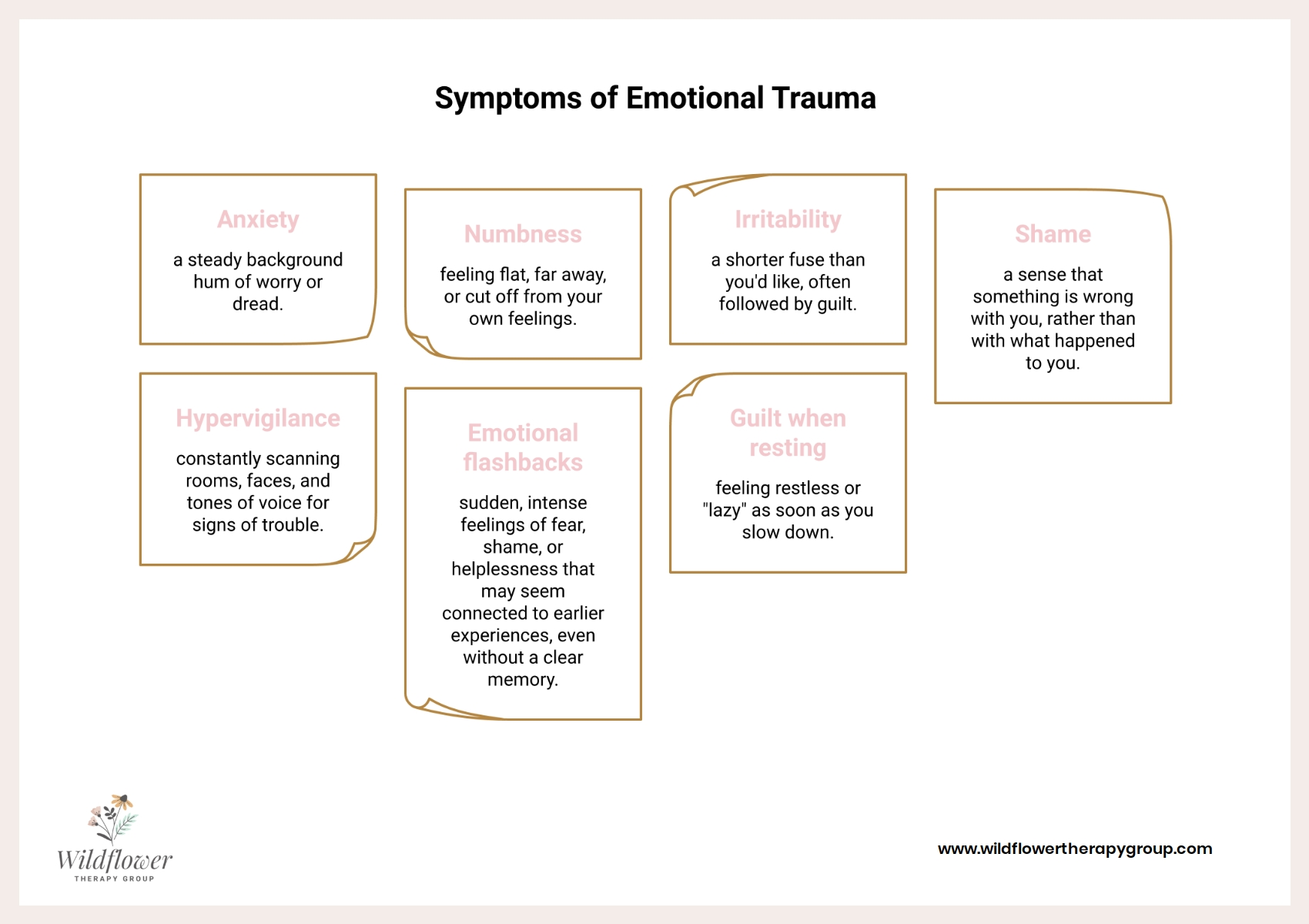
Common symptoms of emotional trauma include anxiety, numbness, irritability, shame, and trouble relaxing, even when there's no immediate danger. They can come and go, and many women notice them most in quiet moments.
Anxiety: a steady background hum of worry or dread.
Numbness: feeling flat, far away, or cut off from your own feelings.
Irritability: a shorter fuse than you'd like, often followed by guilt.
Shame: a sense that something is wrong with you, rather than with what happened to you.
Hypervigilance: constantly scanning rooms, faces, and tones of voice for signs of trouble.
Emotional flashbacks: sudden, intense feelings of fear, shame, or helplessness that may seem connected to earlier experiences, even without a clear memory.
Guilt when resting: feeling restless or "lazy" as soon as you slow down. This post explains why you can't relax without feeling guilty.
The Four Patterns in Plain Words
Clinicians often sort the symptoms of PTSD into four broad patterns, as the National Institute of Mental Health describes. Think of them as ways a protective nervous system behaves. They aren't a checklist to score yourself against.
Intrusion symptoms (re-experiencing): flashbacks, nightmares, or strong reactions to triggers that echo the past.
Avoidance: staying away from places, people, or thoughts that bring it back.
Negative changes in thoughts and mood: feeling detached, hopeless, ashamed, or cut off from joy.
Changes in arousal and reactivity: feeling jumpy, on edge, easily startled, or unable to sleep.
Subtle Everyday Signs: People-Pleasing, Over-Functioning and the "I'm Fine" Trap
Trauma can look like competence. Over-apologizing, perfectionism, trouble holding boundaries, and always being the person everyone relies on can all be protection patterns that once kept you safe.
Fawning is a trauma response in which you calm or please other people to stay safe. It can look like people-pleasing, saying yes when you mean no, and ignoring your own needs. People often praise it as kindness or reliability, so it's easy to miss. You can learn more about fawning and people-pleasing.
These ways of coping make sense, but they cost a lot of energy. You don't need to be in crisis, be diagnosed with PTSD, or have a dramatic story to deserve support.
Ready to Begin Your Healing Journey?
Wildflower Therapy Group offers trauma-informed, holistic therapy for women in Raleigh and online across North Carolina. Start with a free 15-minute consultation.
Get StartedHow Trauma Shows Up in Relationships and Work
In relationships, trauma can show up as recurring patterns. You might find it hard to trust, brace for conflict, or feel oddly at home in chaos because it's familiar. At work, it can look like over-functioning until you burn out. Not sure what you're dealing with? This guide to the difference between stress, burnout, and trauma can help you sort it out.
Can Emotional Abuse Cause PTSD?
Yes. Ongoing emotional abuse and coercive control can cause trauma responses, including PTSD and complex trauma. Abuse doesn't have to be physical to change how safe your nervous system feels.
After a toxic relationship, many women notice hypervigilance, doubts about their own memory, and shame about having stayed. These can be understandable responses to living under threat. They aren't proof that you were weak or naive.
Can emotional abuse cause PTSD?
Yes. Ongoing emotional abuse and coercive control can cause trauma responses, including PTSD and complex trauma. Abuse doesn't need to be physical to leave your nervous system on high alert. Many women notice hypervigilance, self-doubt, and shame afterward. These are understandable responses to living under threat, not signs of weakness.
Why Trauma Symptoms Can Look Different in Women
Women are more likely than men to develop PTSD, and the kinds of trauma women face more often may be part of the reason. About 8 in 100 women and 4 in 100 men will have PTSD at some point in their lives, according to the National Center for PTSD. Women are also more likely to experience sexual assault and child sexual abuse, forms of interpersonal violence that can make someone more likely to develop PTSD.
Other factors may shape how PTSD in women often shows up. These include a tendency toward inward symptoms like anxiety, shame, and withdrawal, and caretaking roles that reward putting yourself last. Researchers are still working out what role hormonal shifts across pregnancy, postpartum, and perimenopause may play. Inward symptoms like these are one reason women with PTSD are often told it's "just stress."
Culture and race matter as well. How trauma is expressed, named, and believed varies widely between communities, and discrimination can itself be a source of trauma. None of this is a character flaw.
Postpartum and Birth Trauma Symptoms
Birth can be traumatic. Some women experience PTSD symptoms after a difficult delivery, an emergency procedure, or a frightening medical experience, even when others tell you the birth "went fine."
Intrusive memories of the birth that replay without warning.
Avoiding medical settings, including follow-up appointments.
Feeling detached from your baby or from yourself.
Panic and hypervigilance, often focused on your baby's safety.
Wildflower Therapy Group offers birth trauma and motherhood support for this season of life.
Normal Stress Reaction or Something More? Timelines, PTSD and Complex Trauma
Many stress reactions ease within a few weeks. If symptoms last longer than about a month, get worse, or disrupt your sleep, relationships, or work, it's a sign to reach out for support. The National Institute of Mental Health notes that PTSD symptoms usually begin within 3 months of a traumatic event, though they sometimes emerge later.
Often a normal stress reaction: you feel shaky, teary, or on edge for days to weeks; it eases gradually, and daily life mostly stays intact.
Possibly something more: symptoms last beyond a month, get stronger, or crowd out sleep, work, and connection.
PTSD vs. Complex Trauma in Plain Language
PTSD can develop after a single traumatic event or repeated traumatic experiences. Complex trauma generally refers to prolonged or repeated exposure to distressing or threatening situations, often within relationships. Some people develop complex PTSD, which involves PTSD symptoms alongside difficulties with emotional regulation, self-image, and relationships.
Only a licensed clinician or mental health professional can assess what's going on for you. This article describes patterns, not a diagnosis of any mental health condition.
How to Get Over Trauma: What Actually Helps
Instead of "getting over" trauma, many women find it more helpful to resolve and integrate it, so the past starts to feel like the past. You don't have to remember every detail or talk about it endlessly for therapy to help.
Why Talk Therapy Alone May Not Reach the Nervous System
Trauma responses live partly in the body's stress response, below the level of logic. You can understand exactly why you react and still feel your heart race. Cognitive behavioral therapy (CBT) is a well-researched option that helps many people. Some women find it useful to pair it with approaches that include the body.
When EMDR, Brainspotting and Somatic Work Fit
Eye movement desensitization and reprocessing (EMDR) is a well-studied way to treat PTSD. The U.S. Department of Veterans Affairs lists it as an evidence-based treatment that has been shown to reduce PTSD symptoms. In EMDR, you pay attention to back-and-forth movements, taps, or sounds while recalling a memory.
Brainspotting uses specific eye positions to help you reach and process stored stress. Its research base is still early, though growing. Somatic and nervous system work focuses on noticing body sensations, going at a steady pace, and building a felt sense of safety. At Wildflower Therapy Group, our trauma therapy blends these approaches at your pace, and nothing is forced.
Between Sessions: Grounding, Breath, Movement and Sleep
Grounding: name five things you can see, or press your feet into the floor.
Breath: try making your exhalation slightly longer than your inhalation to signal safety.
Movement: gentle walking or stretching to release stored tension.
Sleep: a calm, predictable wind-down routine with dim light.
How to Support a Woman Who May Be Experiencing Trauma
One of the most supportive things you can do is listen without immediately trying to fix anything.
Skip "just relax": it can sound like blame, even when you mean well.
Respect her pace: let her decide what to share and when.
Don't push for details: she doesn't owe anyone her story.
Offer practical help: help her find a therapist if she wants one.
How do you get over trauma?
Many women find it more helpful to resolve and integrate trauma than to get over it. With support, approaches like EMDR, CBT, somatic therapy, and Brainspotting may help your nervous system settle so the past feels more like the past. EMDR has the strongest evidence for PTSD, while Brainspotting research is still developing. You don't need to remember everything or retell your story endlessly.
When to Reach Out: Support in Raleigh and Crisis Resources
If your symptoms linger, get worse, or disrupt your sleep, relationships, or work, support can help. A good trauma therapist puts safety and pacing first, and nothing is forced. You're welcome to ask about insurance, out-of-network superbills, or FSA/HSA use before you begin. You can read about trauma therapy at Wildflower or schedule a free consultation.
If You Need Support Right Now
988 Suicide & Crisis Lifeline: call or text 988.
National Domestic Violence Hotline: 1-800-799-7233.
RAINN (sexual assault): 1-800-656-4673.
Crisis Text Line: text HOME to 741741.
Your Symptoms Make Sense: Book a Free Trauma Therapy Consultation in Raleigh
Trauma symptoms in women can include physical tension, anxiety, over-functioning, and recurring relationship patterns. These are understandable responses from a nervous system that learned to protect you. They aren't a personal flaw, and you don't need to be in crisis to ask for support.
Wildflower Therapy Group offers trauma therapy for women in Raleigh, NC, and online, including EMDR (the best-studied of these approaches for PTSD), EMDR intensives, Brainspotting, somatic therapy, and nervous system regulation. This approach may suit women who want to work through past trauma at their own pace. To start, book a free 15-minute consultation by calling (919) 524-3390 or emailing info@wildflowertherapygroup.com. You can ask about fit, pacing, and insurance before deciding.