
If your mind races, your chest tightens, or old memories keep pulling you out of the present, you might be wondering if EMDR for anxiety disorders could help. It can, especially with anxiety patterns tied to distressing memories.
EMDR stands for eye movement desensitization and reprocessing. The evidence is strongest for PTSD, while research on other anxiety concerns is promising but more limited.
At Wildflower Therapy Group in Raleigh, NC, and online through virtual sessions, EMDR is one part of a blended, trauma-informed approach.
This guide covers how EMDR works, what research says about EMDR and anxiety disorders, how it compares with CBT, the eight phases, timelines, and safety. It's educational, not medical advice.
Why Talking It Out Hasn't Calmed Your Anxiety
Maybe you understand exactly where your anxiety comes from and still feel it anyway. That doesn't mean you're broken. Anxiety can also show up in the body and be influenced by how distressing memories are processed, so insight alone doesn't always shift it. Traditional talk therapy can build real understanding and help many people. But sometimes your nervous system needs something different, too.
Past stress you never called "trauma" can still fuel anxiety today. A toxic relationship, a frightening birth, a loss, or years of walking on eggshells can teach your body to stay on alert. Seeing that link isn't about blame. It's information you can work with.
What Is EMDR Therapy for Anxiety, and How Does It Work?
EMDR therapy is a structured, evidence-based psychotherapy that helps your brain reprocess memories that still feel "stuck." You briefly hold a memory in mind while following bilateral stimulation, meaning rhythmic left-right input like eye movements, audio tones, or tapping. Over time, many people find the memory feels less intense and less tied to present-day alarm.
Psychologist Francine Shapiro developed EMDR. Researchers still debate exactly why it works. One theory suggests that incompletely processed memories remain linked to the body's threat response, and reprocessing may loosen that link. Another is that holding a memory while tracking eye movements may make it feel less vivid. Either way, the goal is to support your brain's natural ability to file an experience as "over." You can read more about how EMDR therapy works at Wildflower.
What Does an EMDR Session Look Like?
You remain awake and can communicate with your therapist, request a pause, or stop the process at any time. Your therapist helps you choose a target, such as a memory, a trigger, or a body sensation. You also name the negative belief attached to it, like "I'm not safe." Then you follow short sets of bilateral stimulation and pause to notice what comes up.
What Are SUDS Ratings (0-10)?
SUDS stands for Subjective Units of Disturbance, sometimes called Subjective Units of Distress. It's a simple 0-10 rating of how upsetting a memory feels right now. APA's EMDR overview describes zero as no disturbance (neutral) and 10 as the most disturbance you can imagine. Your therapist checks it before, during, and after reprocessing to track change. It isn't a test, and there's no wrong answer.
Do I have to talk through every detail of a memory?
No. EMDR doesn't ask you to retell everything in detail. You share enough for your therapist to understand the target, and much of the work happens quietly as you notice thoughts, images, and sensations. You can pause or stop at any time, and your therapist adjusts the pace with you.
Can EMDR Help With Anxiety Disorders, Not Just PTSD?
Yes, EMDR can help with anxiety, especially when it's connected to distressing memories or specific triggers. Research on EMDR for anxiety concerns is still developing, and a 2020 meta-analysis called for more long-term studies. The evidence is strongest for PTSD. Research is promising but more limited for panic symptoms and phobias, and still emerging for social anxiety. A trained therapist can help you decide whether it fits your patterns.
Post-traumatic stress disorder (PTSD) is a trauma response in which a traumatic event keeps replaying through intrusive memories, constant alertness, or avoidance long after the danger has passed. Although PTSD is no longer classified as an anxiety disorder, it can involve significant anxiety symptoms and has the strongest evidence base for EMDR treatment. The 2023 VA/DoD guideline found that EMDR, Cognitive Processing Therapy (CPT), and Prolonged Exposure (PE) remain the most effective treatments. The WHO's 2013 guidelines also recommend trauma-focused CBT and EMDR for PTSD in adults, children, and adolescents.
Anxiety and depression often overlap, so it helps to look at the whole picture. You can explore other support for anxiety and depression that can work alongside EMDR.
EMDR for Panic Disorder and Panic Symptoms
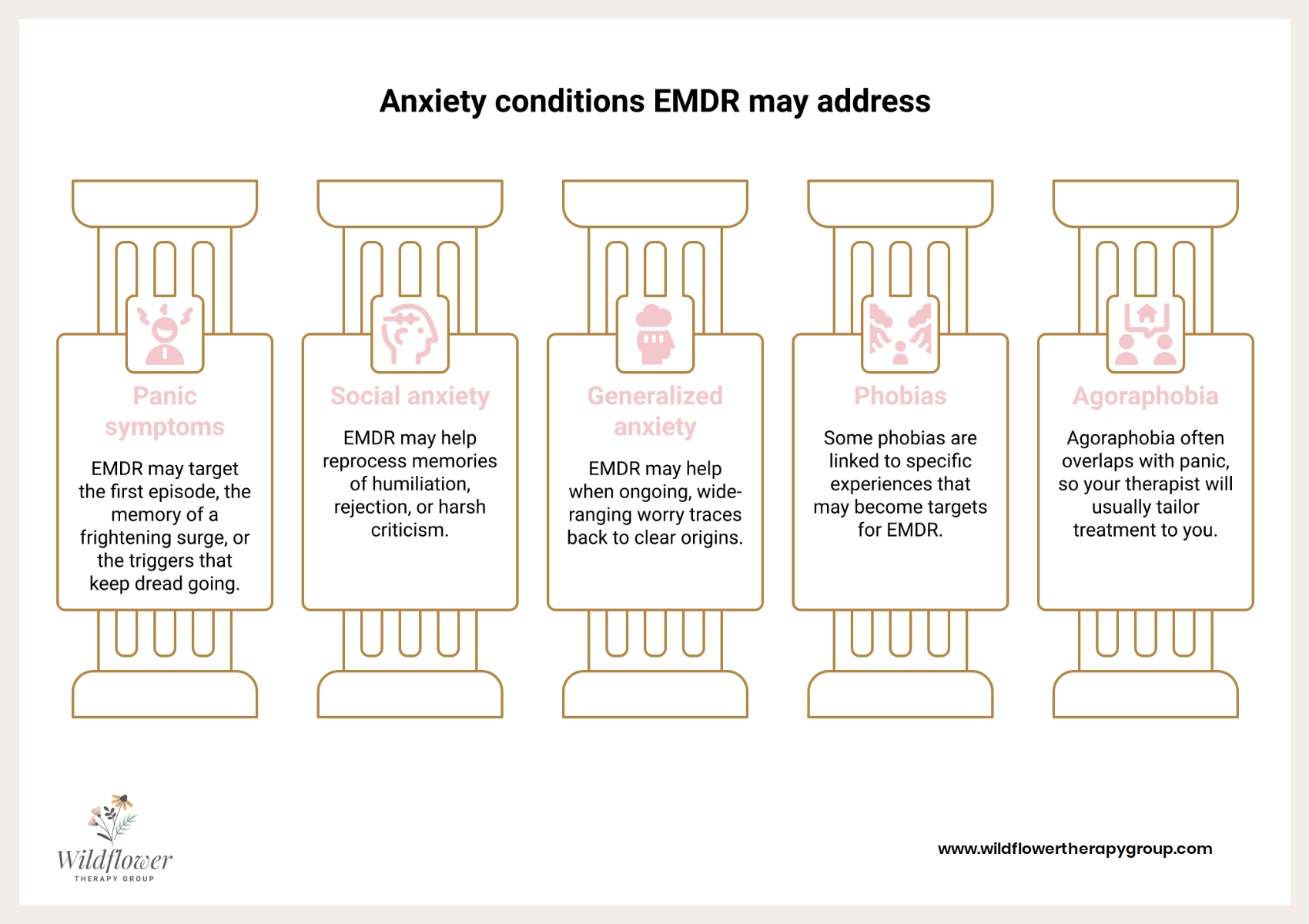
Panic symptoms can involve sudden surges of fear and a constant dread of the next one. EMDR may target the first episode, the memory of a frightening surge, or the triggers that keep that dread going. The evidence here is limited and mixed, according to a 2017 Frontiers review, and CBT-based approaches also have strong support for panic.
EMDR for Social Anxiety
Past moments of humiliation, rejection, or harsh criticism can keep social anxiety going. EMDR may help reprocess those memories so meetings, dates, or group settings feel less loaded. Research on EMDR for social anxiety is limited but growing.
Generalized Anxiety, Phobias, and Agoraphobia
Generalized anxiety is ongoing, wide-ranging worry, and it's often less tied to one memory. EMDR may help when that worry traces back to clear origins. Some phobias are linked to specific experiences that may become targets for EMDR. Agoraphobia often overlaps with panic, so your therapist will usually tailor treatment to you.
Is EMDR or CBT Better for Anxiety?
Neither is better for everyone. CBT has a larger evidence base for most anxiety disorders, while EMDR is an established treatment for PTSD and may be considered for other anxiety symptoms associated with distressing experiences. Many people choose based on fit: how each approach feels, what they want to work on, and what their therapist recommends.
The two approaches feel different. According to the WHO guidelines, "Unlike CBT with a trauma focus, EMDR does not involve (a) detailed descriptions of the event, (b) direct challenging of beliefs, (c) extended exposure, or (d) homework."
| EMDR | CBT | |
|---|---|---|
| Focus | Reprocessing memories and triggers | Changing thoughts and behaviors |
| How sessions feel | Less talking, more noticing | Structured, skills-based conversation |
| Homework | Usually none | Usually practice between sessions |
| Evidence base | Strongest for PTSD | Broad across anxiety concerns |
| May suit you if | Past experiences feel central | You want concrete tools and practice |
Exposure therapy is part of the CBT family. It gradually and safely helps you face feared situations, and it also has strong support. You can combine these approaches, and a therapist can help you sort out which one fits best.
What Are the 8 Phases of EMDR?
EMDR treatment follows eight phases. Your therapist moves through them at your pace, and some phases repeat as you work on different memories.
History and treatment planning: You map your history and goals together and build a treatment plan.
Preparation: You learn grounding and calming skills and what to expect.
Assessment: You pick a target memory, its negative belief, a preferred belief, and a SUDS rating.
Desensitization: You reprocess the target memory using bilateral stimulation while your therapist monitors changes in distress.
Installation: You strengthen the preferred belief, such as "I'm safe now."
Body scan: You check for leftover tension or body sensations.
Closure: You return to calm before the session ends.
Reevaluation: You review progress at the start of the next session.
Phases 1 and 2 are where stabilization happens, so reprocessing doesn't begin until you're ready.
Ready to Begin Your Healing Journey?
Wildflower Therapy Group offers trauma-informed, holistic therapy for women in Raleigh and online across North Carolina. Start with a free 15-minute consultation.
Get StartedHow Long Does EMDR Take to Work?
It varies. Some people notice shifts within a handful of sessions, while others need longer. Timelines depend on your history, how many memories are involved, how much preparation you need, and your pacing. There's no guaranteed timeline. A good therapist will check in on your progress with you rather than rush it.
Processing a single frightening event may differ from working through layered experiences, like a long toxic relationship. Format matters, too. Weekly sessions suit many people, while EMDR intensives fit the work into longer, more focused blocks. If you're curious, read about whether an intensive is right for you and why an intensive might help. You might also want to see how EMDR may support nervous system regulation.
Can EMDR help with both anxiety and depression?
It may. Anxiety and depression often overlap, and both can be shaped by painful past experiences. When memories feed hopelessness or worry, reprocessing them may ease both. Research for depression is less established than for PTSD, so a therapist can help you decide whether EMDR, another approach, or a combination fits.
Is EMDR Safe? What to Expect Between Sessions
EMDR is widely used, but reprocessing can stir things up for a while. After a session, emotions, vivid memories, dreams, or tiredness may briefly rise. These reactions can occur and are often temporary.
Some people experience a bigger increase in distress than they expected, and some need more preparation before memory reprocessing begins. That's why stabilization comes first. You build grounding skills before any reprocessing, and your EMDR therapist checks in with you at every step and can slow down or spend more time on preparation if you need it. These EMDR aftercare tips can help you care for yourself afterward.
EMDR is also available through virtual sessions. If you choose that option, your therapist will help you set up a private, comfortable space and plan how to settle afterward, so the same pacing and safety steps apply.
If you take medication, keep your prescriber informed and don't change anything without talking to them. If you're ever in crisis, you can call or text 988 or visit the 988 Suicide & Crisis Lifeline. This article is educational and isn't medical advice.
How to Find a Certified EMDR Therapist
Choosing a therapist is personal. Whether you're in Raleigh or nearby, or you'd rather meet virtually, this checklist can help you figure out what to ask.
Training: Ask whether they completed EMDRIA-approved training or are an EMDRIA Certified Therapist. If they're certified or a consultant with EMDRIA, you can check their credentials in the EMDRIA directory, as EMDRIA's guide explains.
Preparation: Ask how they handle stabilization before reprocessing.
Anxiety experience: Ask how they work with anxiety patterns and panic symptoms.
Pacing: Ask about session format and what happens if something feels too intense.
Coordination: Ask how they work with prescribers or other providers.
Payment: Ask about insurance, FSA/HSA use, or out-of-network superbills.
Fit: Notice whether you feel comfortable. As one Psychology Today guide notes, "EMDR works best when you feel safe, connected with, listened to, and supported by your EMDR therapist."
How can I get help with anxiety? A good first step is a conversation with a licensed therapist about your patterns and options.
If you'd like to talk it through, Wildflower Therapy Group offers a free, no-pressure consultation. It's an opportunity to ask questions rather than receive a diagnosis.
What resources are available for people with generalized anxiety?
Options include therapy approaches like CBT and EMDR, support from your primary care provider, and nervous system regulation skills like grounding and paced breathing. A licensed therapist can help you build a plan. If you're in crisis, call or text 988 to reach the 988 Lifeline.
Let Your Mind Settle: Book a Free EMDR Therapy Consultation in Raleigh
EMDR helps your brain reprocess memories that keep your body on alert. When it comes to EMDR for anxiety disorders, the research is strongest for PTSD and more limited for other anxiety concerns, like panic symptoms and phobias. Preparation and pacing come first, so you build stability before any reprocessing begins. Healing isn't one-size-fits-all, and EMDR is one option among several.
Wildflower Therapy Group offers EMDR in Raleigh, NC, and through virtual sessions, alongside trauma therapy, somatic therapy, and nervous system regulation work. This approach may suit you if past experiences seem to drive your anxiety and you'd prefer not to retell every detail. To set up a free consultation, call (919) 524-3390 or email info@wildflowertherapygroup.com. You can also learn more about EMDR therapy at Wildflower Therapy Group.