
Attachment-focused EMDR (AF-EMDR) is a modified form of EMDR therapy developed by Dr. Laurel Parnell. It places greater emphasis on resourcing and the therapeutic relationship when reprocessing early relational wounds.
Maybe talk therapy helped you understand your patterns, but they still run the show. Maybe you've been white-knuckling your way through life, living in your head and performing "okay." If you're looking for an attachment-focused EMDR therapist in Raleigh, this plain-English guide explains how AF-EMDR works, what sessions feel like, and how to choose a specialist.
What Is Attachment-Focused EMDR?
Attachment-focused EMDR is a form of EMDR therapy adapted for wounds that formed in early relationships. It emphasizes building inner resources and a sense of safety before reprocessing. From there, it gently works through painful memories and the beliefs tied to them. The relationship with your therapist is part of the repair, not just the setting for it.
EMDR stands for eye movement desensitization and reprocessing. Its standardized procedures use eye movements and other forms of rhythmic left-right (bilateral) stimulation, such as tones or taps. You may also see the approach referred to as attachment-based EMDR. Dr. Parnell laid out the approach in her book Attachment-Focused EMDR: Healing Relational Trauma (New York: W. W. Norton, 2013).
Where AF-EMDR Came From (Dr. Laurel Parnell)
Francine Shapiro developed standard EMDR in the late 1980s. Dr. Laurel Parnell later adapted it for people whose deepest wounds are relational. Her official site describes an attachment-focused approach built around a safe, therapeutic relationship. She's the executive director of the Parnell Institute and the developer of Attachment-Focused EMDR.
Today, attachment-focused EMDR is taught by more than one training organization. The Parnell Institute is tied directly to Dr. Parnell's work, while other EMDRIA-approved programs, such as the Personal Transformation Institute, build attachment and somatic focus into their EMDR training. The approaches overlap considerably. Whichever program a therapist names, training alone doesn't guarantee they'll be the right fit for you.
What "Relational Trauma" Means
Relational trauma refers to distressing experiences within important relationships, particularly those you depended on early in life. It can come from inconsistent care, a parent who was emotionally absent, constant criticism, or needs that went unmet. It isn't always one big event. Often it's many small moments that taught your nervous system what closeness costs.
Why Talk Therapy Alone May Not Have Stuck
Patterns that formed early can shape your nervous system's stress responses, not only your thoughts. That's why insight alone often doesn't shift them. You can understand exactly why you do something and still find yourself doing it. That's common, and it isn't a failing.
Your system learned to brace long before you had words for what was happening. Talk therapy can help you understand your experiences and develop new coping strategies. Some people also benefit from approaches that pay attention to physical sensations and automatic stress responses, like a tight chest or sudden shutdown. Learn more about how EMDR supports nervous system regulation.
What does an attachment-focused EMDR therapist do?
An attachment-focused EMDR therapist uses EMDR to help with hurt rooted in early relationships. They build safety and inner resources first, then gently reprocess painful memories and the beliefs tied to them. The therapeutic relationship itself is part of the work, so attunement, consistency, and your sense of choice matter throughout every session.
Attachment Wounds in Everyday Life: Patterns You May Recognize
Attachment wounds often show up as everyday habits rather than obvious "trauma." Attachment theory suggests that your earliest bonds shape what you expect from closeness, safety, and support. The patterns below aren't labels. They're familiar experiences that may sound like you.
Over-Functioning, Achieving, and Struggling to Receive Support
You may earn your worth by doing: staying productive, being the reliable one, and handling it all yourself. Asking for help can feel risky, and receiving it can feel strangely uncomfortable. Part of you may always be bracing for something to go wrong.
People-Pleasing and Fawning
Fawning is a trauma response that can look like people-pleasing, over-apologizing, and ignoring your own needs. You might say yes to keep the peace, or minimize your needs to avoid disappointing others. It's a safety response your system learned, not a character flaw. You can read more about why people-pleasing can be a way of feeling safe.
Repeating Dynamics in Relationships, Including Toxic Ones
Old patterns have a way of recreating themselves in new relationships. You may notice yourself drawn to the same dynamics or staying in relationships longer than feels healthy. That's not a flaw in you. It's your nervous system reaching for what feels familiar. If you're curious about the physical side, here's how a toxic relationship can affect your nervous system.
Attachment-Focused EMDR vs. Standard EMDR
Standard EMDR has a strong evidence base for PTSD, while attachment-focused EMDR adapts the approach to place greater emphasis on early relational experiences. It puts particular weight on preparation, resourcing, and relational attunement. The two differ in emphasis, and neither approach is inherently better for everyone.
| Feature | Standard EMDR | AF-EMDR |
|---|---|---|
| Focus | Specific distressing memories | Early relational wounds and attachment patterns |
| Preparation and resourcing | Included before processing | Expanded, ongoing and woven throughout |
| Role of the therapeutic relationship | A supportive container | An active part of the repair |
| Typical target memories | Single or repeated distressing experiences, including childhood trauma | Often early memories tied to caregiving and close relationships |
| Pacing | Individualized to your readiness and treatment needs | Places particular emphasis on preparation, resourcing, and relational attunement |
| Best suited for | Many types of trauma | People whose pain centers on early relationships |
Explore how we approach EMDR therapy in Raleigh for the bigger picture.
How AF-EMDR Compares to IFS and Somatic Therapy
Internal Family Systems (IFS) focuses on different internal "parts," such as the protector or the inner critic. Somatic therapy works through body awareness: noticing sensation, breath, and movement to help you regulate. AF-EMDR pairs resourcing and the relationship with reprocessing. These approaches can complement each other. See Brainspotting vs. EMDR and somatic therapy vs. body-based exercises for more comparisons.
How AF-EMDR Works: Resourcing, the Therapeutic Relationship, and Change in Daily Life
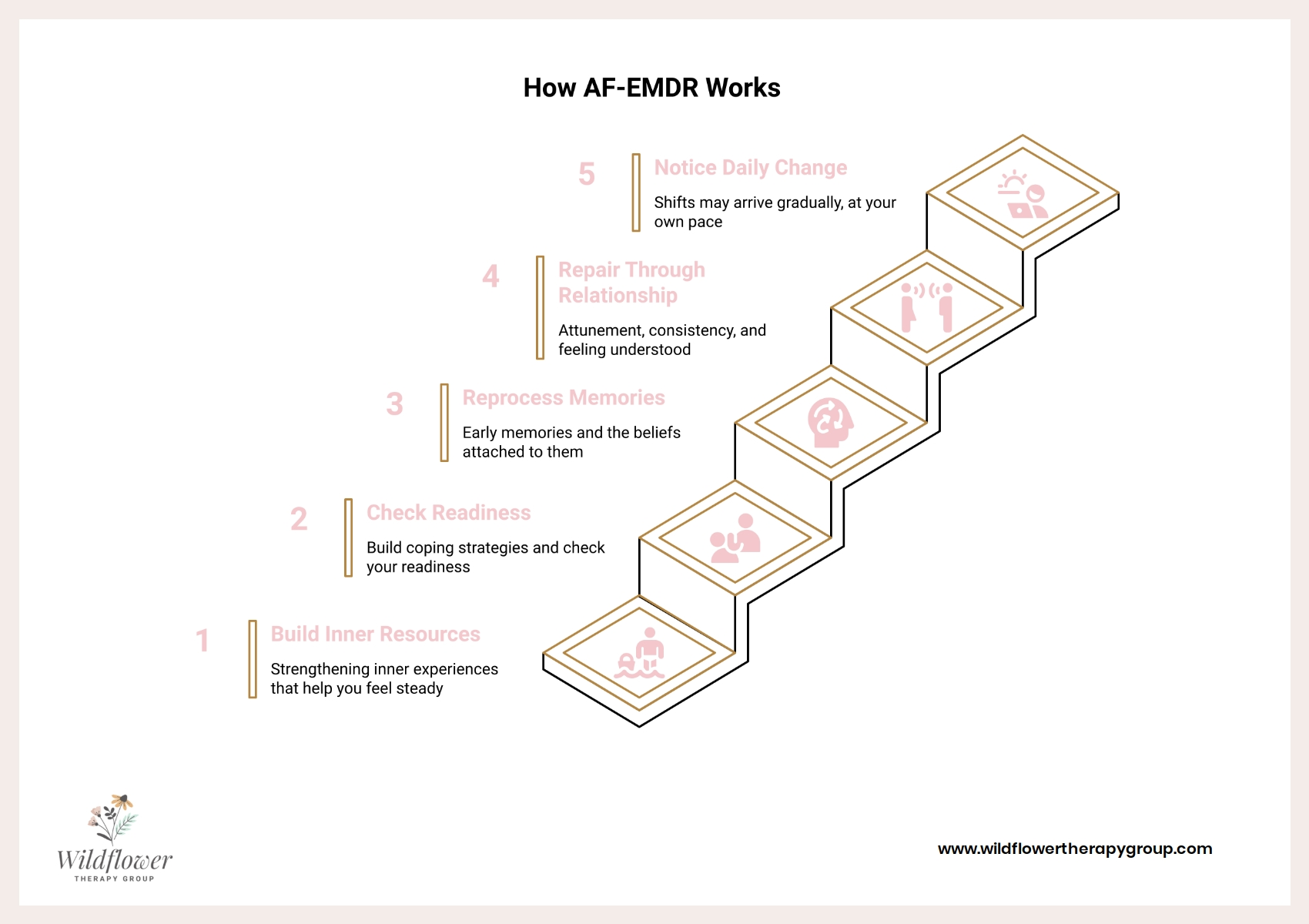
AF-EMDR follows a steady sequence. First, you build safety and inner resources so your nervous system has something solid to lean on. Then you and your therapist reprocess painful early experiences in manageable pieces. Throughout, the relationship itself helps repair, offering the attunement and consistency that may have been missing early on.
Resourcing First: Building Safety Before Processing
Resourcing means strengthening the inner experiences that help you feel steady. Your therapist may use slow bilateral stimulation, such as gentle tapping, while you picture a calm place or a nurturing, protective figure. They also help you build coping strategies and check your readiness before memory reprocessing begins. You can ask for a pause or adjustment whenever you need one.
The Therapeutic Relationship as a Repair Tool
In AF-EMDR, how your therapist shows up matters. Attunement, consistency, and feeling understood by your therapist may help you develop healthier expectations of relationships. The relationship isn't just the backdrop for the work. It's part of the work. Learn more about our EMDR therapy approach.
EMDR for Attachment Trauma: What Gets Reprocessed
Reprocessing focuses on early memories and the beliefs attached to them, such as "I'm too much" or "I have to earn love." As those memories are processed, their emotional charge may loosen. The goal is for the past to feel more like the past. Everyone's experience is different.
How Change Shows Up in Daily Life
Change is often quiet. Some people notice improved sleep, less bracing and physical tension, or fewer tension headaches. Others notice steadier reactions or calmer relationships. There's no set timeline, and shifts may arrive gradually, at your own pace.
"Will This Open Pandora's Box?" You Set the Pace
This is one of the most common fears, and it makes sense. In AF-EMDR, you set the pace. Reprocessing typically begins once you and your therapist agree you have enough preparation and support, and you can say "slow down" or "stop" at any point. Safety and resourcing run through every phase, not just the beginning.
Who May Need Stabilization First
Some people need more grounding, support, or inner resources before reprocessing begins. A good therapist assesses this early. Stabilization is a caring step, not a setback. It means building a sturdier foundation first.
Format matters too. EMDR intensives, which are longer, concentrated sessions, suit some people and not others. Read how to know if EMDR intensives are right for you, or learn about EMDR intensive therapy at Wildflower.
Attachment-Focused EMDR Training: What to Look For
The key distinction is "trained in" versus "certified." A therapist trained in a particular method has completed relevant instruction in it. Certification is a formal credential with set requirements reviewed by a professional body. Both are meaningful. They tell you different things, so ask which one applies.
For EMDR in general, EMDRIA (the EMDR International Association) offers certification. To earn this credential, clinicians complete an EMDRIA-approved EMDR Basic Training and conduct at least 50 EMDR therapy sessions with a minimum of 25 clients, along with at least 20 hours of consultation, according to EMDRIA's certification page.
Attachment-focused training is specialized coursework that builds on EMDR, and more than one program teaches it.
The Parnell Institute is the name most closely tied to Dr. Parnell's method. The Personal Transformation Institute (PTI), an EMDRIA-approved training provider, teaches a closely related approach called S.A.F.E., short for Somatic and Attachment Focused EMDR.
The two share a lot of common ground: both put safety, resourcing, and the therapeutic relationship at the center of the work.
Ready to Begin Your Healing Journey?
Wildflower Therapy Group offers trauma-informed, holistic therapy for women in Raleigh and online across North Carolina. Start with a free 15-minute consultation.
Get StartedThe S.A.F.E. Approach to Attachment-Focused EMDR
PTI founder Deb Kennard developed the S.A.F.E. approach to make attachment and nervous system regulation easier to work with in EMDR. It draws on attachment theory, somatic therapies, mindfulness, and neurobiological models of regulation.
Standard EMDR is guided by the Adaptive Information Processing (AIP) model, which focuses on memories that were too overwhelming to process at the time. S.A.F.E. builds on that model by also paying attention to how trauma affects your ability to regulate your nervous system and connect with others.
A central idea in S.A.F.E. is what PTI calls "the Answer": the adaptive response you developed, usually in the face of distress, to feel as safe and connected to your caregivers as possible.
Patterns like people-pleasing, over-functioning, or shutting down can be understood this way. Rather than treating them as problems to get rid of, a S.A.F.E.-trained therapist respects why they formed and works with them gently. The approach is guided by four principles: nonviolence, mindful awareness, compassionate assumption, and healthy boundaries.
Whichever program a therapist trained with, EMDRIA certification shows depth in EMDR overall, and attachment-focused training shows a specific relational focus.
EMDRIA certification doesn't by itself show attachment-focused training, and not every EMDR therapist offers it, so it's worth asking about both directly. At Wildflower, Jaclyn Sappah has both: she's an EMDRIA-Certified Therapist trained in the S.A.F.E. approach through PTI.
How is attachment-focused EMDR different from regular EMDR?
Both use the same core EMDR framework. Attachment-focused EMDR places more emphasis on resourcing before processing, uses the therapeutic relationship as a repair tool, and often targets early relational experiences rather than single events. It's a difference of emphasis, not a judgment on standard EMDR, which is well supported for trauma.
8 Questions to Ask an Attachment-Focused EMDR Therapist
What training do you have in attachment-focused EMDR? Are you trained in it or certified, and through which organization? A good answer names the training clearly and doesn't blur the two.
How do you build safety and resources before processing? Listen for specific resourcing tools, not "we jump right in."
How do you pace sessions? A good answer puts your choice and comfort at the center.
What if I feel overwhelmed mid-session? Expect a concrete plan for grounding, pausing, or stopping.
How do you decide whether I need stabilization first? Look for an early, collaborative assessment.
Do you offer telehealth, and where? They should explain clearly which states they're licensed in.
What does progress look like, and how will we know? A good answer describes regular check-ins, not promised timelines.
What are your insurance and billing options? Ask the practice directly, since this varies by practice and plan.
A free 15-minute consultation is a good time to ask these questions. There's no pressure, and you can go at your own pace. If you use a contact form, please don't include sensitive personal or health details.
What the Research Says: EMDR and Relational Trauma Therapy
EMDR as a whole has meaningful research support for trauma. The WHO stress guidelines from 2013 state that individual or group trauma-focused CBT, EMDR, or stress management should be considered for adults with PTSD.
Among psychotherapies, the 2023 VA/DoD guideline recommends Cognitive Processing Therapy (CPT), EMDR, and Prolonged Exposure (PE). You can review the VA/DoD PTSD guideline directly.
The American Psychological Association's PTSD guideline also suggests EMDR for the treatment of PTSD, as the APA's EMDR overview explains.
Research on attachment-focused versions of EMDR, including Parnell's AF-EMDR and PTI's S.A.F.E. approach, is still limited. Much of the available literature on AF-EMDR consists of clinical descriptions and case reports. For example, Parnell's book includes cases from different EMDR therapists who used attachment-focused EMDR with their clients.
Both approaches build on the standard EMDR framework that the guidelines above support, adding greater attention to safety, attachment, and nervous system regulation. That's why we describe relational trauma therapy with attachment-focused EMDR as evidence-informed, not proven.
How long does attachment-focused EMDR take?
It varies. The length of therapy depends on your history, your goals, and how much resourcing you need before processing feels steady. Session length varies too, depending on the practice and format. A good therapist won't promise a timeline. Instead, you'll check in together regularly about what's shifting and what you need next.
Start Attachment-Focused EMDR in Raleigh at Your Own Pace
Early relational wounds live in the body, and that's why attachment-focused EMDR puts safety and resourcing first and lets you set the pace.
At Wildflower Therapy Group, Jaclyn Sappah, LCSW, C-IAYT, founder, is an EMDRIA-Certified Therapist trained in PTI's Somatic and Attachment Focused (S.A.F.E.) approach to EMDR. That means the patterns you built to stay safe are met with respect, not judgment, and your body is part of the healing, not just your story.
If your struggles trace back to early relationships and talk therapy alone hasn't fully reached them, this approach may be a good fit. Sessions are available in person in Raleigh and virtually for clients in North Carolina. Licensure and state rules apply. Learn more about our EMDR therapy in Raleigh.
Your next step is a free 15-minute consultation. Call (919) 524-3390 or use the contact form to ask questions and see whether AF-EMDR fits, with no pressure to commit. Please don't share sensitive details in the form. Sessions are held in person in Raleigh and virtually for clients in North Carolina.