
EMDR for childhood trauma is a structured therapy that you move through at your own pace. It helps your brain reprocess painful early memories so they feel less intense and more like the past. You don't have to retell every painful detail for your brain to heal. It can help you process the lasting effects of childhood abuse, neglect, sexual trauma, or unsafe family and relationship dynamics.
Healing isn't a race. Here's how EMDR works, what sessions involve, and how to tell whether it fits you right now.
What Is EMDR Therapy and How Does It Work for Childhood Trauma?
EMDR stands for eye movement desensitization and reprocessing. It's an eight-phase psychotherapy that helps you process distressing memories so they carry less emotional charge. Developed by psychologist Francine Shapiro in 1987, EMDR is guided by the Adaptive Information Processing (AIP) model, as described by the American Psychological Association (APA).
The EMDR International Association (EMDRIA) explains that under the AIP model, disturbing experiences get linked in the brain with their original thoughts, feelings, images, and body sensations. In plain language, a traumatic event that overwhelmed you as a child may have been stored with its original fear, body sensations, and beliefs still attached. This may help explain why a certain tone of voice can make you feel small again. Reprocessing helps the memory settle in as something that happened then.
The approach is well researched. The World Health Organization lists eye movement desensitization and reprocessing (EMDR) among its psychological interventions for adults with PTSD. Outcomes still vary from person to person. Reprocessing doesn't require you to recount every detail of what happened. Instead, it helps you work through distressing memories so they may become less emotionally overwhelming. You may still feel some difficult emotions or sensations while you do this work.
How Does Childhood Trauma Show Up in Your Life Decades Later?
Your early experiences taught your nervous system how to protect you. Those protective patterns often keep running long after the danger has passed. They aren't flaws. They're adaptive trauma responses that once helped you get through.
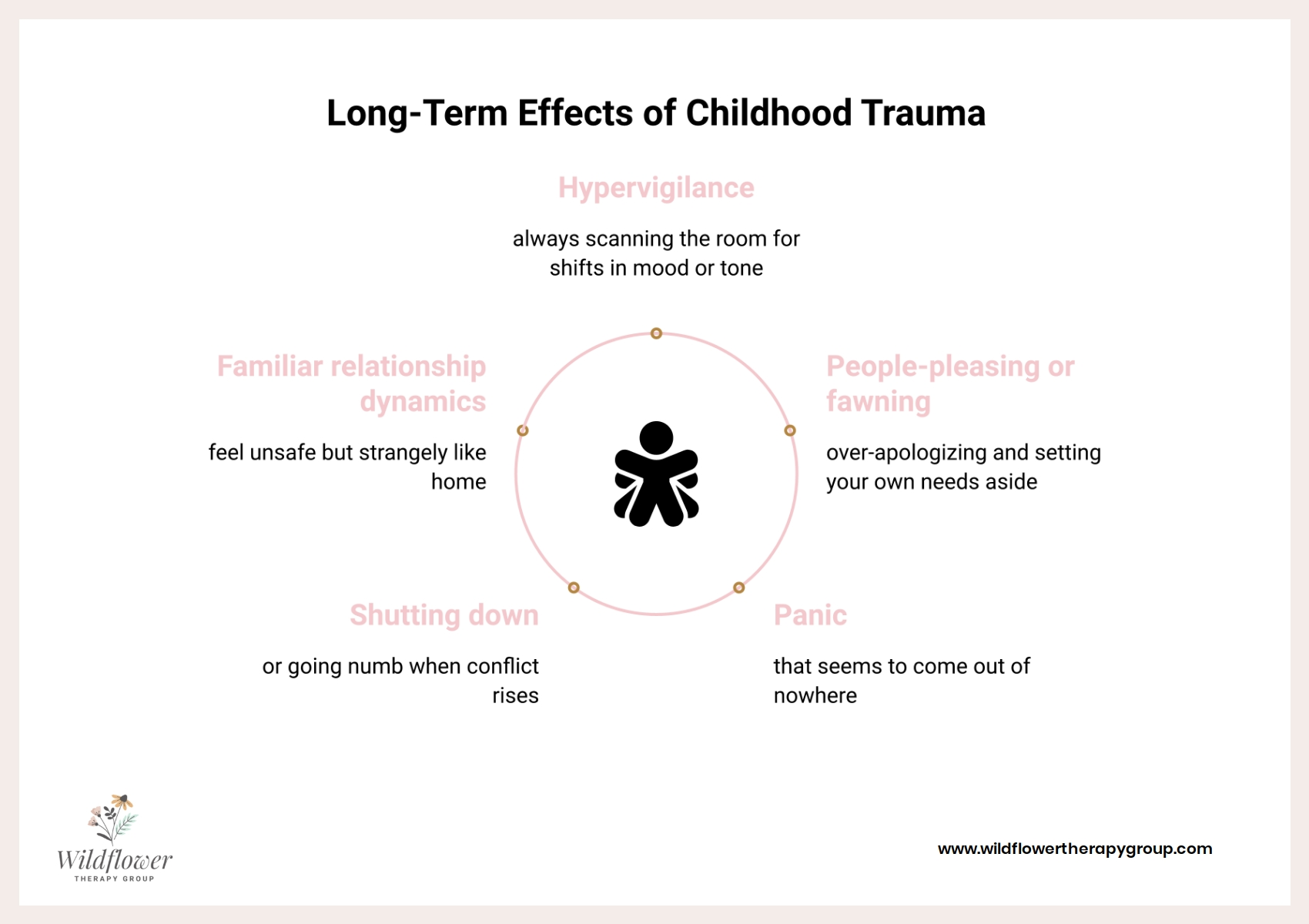
Some of the long-term effects of childhood trauma can look like:
Hypervigilance: always scanning the room for shifts in mood or tone
People-pleasing or fawning: over-apologizing and setting your own needs aside
Panic that seems to come out of nowhere
Shutting down or going numb when conflict rises
Familiar relationship dynamics that feel unsafe but strangely like home
EMDR works with these patterns where they started. You can learn more about how EMDR helps regulate the nervous system. If worry is what shows up most for you, you might also read about EMDR for anxiety.
Is EMDR effective for childhood trauma?
Research suggests EMDR can help reduce trauma-related symptoms after childhood trauma, though the evidence base is still small and results vary. How well it works depends on your history, your readiness for treatment, and your relationship with your therapist. People with similar experiences can move at very different speeds. Neither speed is wrong.
The Eight Phases of EMDR, Step by Step
EMDR follows eight phases, and the first two focus on preparation rather than memory work. These initial phases lay the foundation for safe, individualized treatment. Here are the eight phases in order:
History and planning: You and your therapist map out your goals and choose where to start.
Preparation and resourcing: You develop grounding and coping skills, which may include picturing a calm place or identifying supportive people.
Assessment: You identify a target memory, the negative belief associated with it, and where you feel it in your body.
Desensitization: Bilateral stimulation helps lower the memory's emotional charge.
Installation: A healthier belief about yourself gets strengthened.
Body scan: You check for any tension that's left.
Closure: Your therapist helps you return to a more grounded state, even when a memory hasn't been fully processed.
Reevaluation: At the next session, you review together what has changed.
Preparation and an assessment of your readiness come before memory processing, and you can pause or stop at any point. Learn how we approach EMDR therapy in Raleigh.
How Do Bilateral Stimulation and Eye Movements Reprocess Traumatic Memories?
"Bilateral" means left-right. In EMDR, this can mean following your therapist's hand with your eyes, alternating taps or tones. The APA explains that briefly focusing on a traumatic memory while engaging in bilateral stimulation (BLS) can help reduce the memory's vividness and emotional intensity.
This is called dual attention. You hold the memory loosely while one foot stays firmly in the present. The precise mechanisms behind EMDR remain an area of ongoing research. What doesn't change is that you stay in control, you set the pace, and you can stop at any time.
Turning Childhood Negative Beliefs into Positive Ones
Childhood trauma often leaves behind beliefs that feel like facts. EMDR helps those beliefs shift:
"It was my fault" → "I wasn't responsible for what happened"
"I'm not safe" → "I'm safe now"
"I have to earn love" → "I'm worthy"
The new belief isn't forced or recited like an affirmation. During the installation phase, your therapist helps strengthen a positive belief that feels meaningful and appropriate to you. If your trauma stems primarily from early relationships, you may want to read about attachment-focused EMDR.
Can EMDR for Childhood Trauma Work If You Don't Remember Clearly?
Yes. EMDR can work even if you don't remember clearly. Even when your memories are fragmented or unclear, your therapist may work with distressing emotions, images, beliefs, and physical sensations, such as a tight chest or a sinking stomach.
You don't need a full story of the traumatic experience, and your therapist doesn't need every detail. Often a single image or sensation is enough to begin.
An important limitation: EMDR is not a method for recovering or verifying forgotten memories. Physical sensations, emotions, and emerging images should not be treated as proof that a particular event occurred. The work focuses on how your experiences affect you today.
EMDR vs. Trauma-Focused CBT: What's the Difference?
Both are evidence-based approaches to treating trauma-related symptoms, but they differ in their techniques, treatment structure, and use of between-session practice. Here, trauma-focused CBT means the family of trauma-focused cognitive behavioral approaches, including TF-CBT, which was developed for children and adolescents.
| Approach | Main focus | Verbal processing | Typical format |
|---|---|---|---|
| EMDR | Reprocessing memories and the beliefs tied to them | Detailed verbal recounting is generally not required | Eight phases with bilateral stimulation |
| Trauma-focused CBT | Understanding and reshaping trauma-related thoughts and behaviors | More verbal. Often includes discussing the experience | Structured skills, often with practice between sessions |
Guidelines rate EMDR differently. The VA/DoD guideline recommends three trauma-focused therapies: Cognitive Processing Therapy, EMDR, and Prolonged Exposure. The APA's PTSD guideline suggests EMDR as a treatment option. These guidelines address PTSD, so they don't automatically show the same results for every effect of childhood adversity.
For childhood trauma specifically, a systematic review looked at randomized controlled trials. It included six eligible RCTs with 251 participants and found growing evidence to support the clinical efficacy of EMDR in treating childhood trauma in both children and adults. The best fit depends on your history and preferences, so it's worth talking through with a therapist.
Is EMDR safe for complex trauma?
It can be when readiness comes first. Before memory processing begins, your therapist assesses your ability to manage distress, your current circumstances, and the support available to you. If those pieces aren't in place yet, you build them first. That isn't a setback. It's part of the work.
EMDR Therapy for Childhood Trauma: How Many Sessions Will You Need?
It varies, and no one can honestly promise you a timeline. The APA describes EMDR as typically delivered one to two times per week for a total of 6-12 sessions, although some people benefit from fewer sessions. People with a history of repeated or complex childhood trauma may benefit from more preparation and a longer course of treatment.
Several things shape your timeline:
Your trauma history and how many memories are involved
Your current stress and support
How much stabilization you need first
The pace that feels right to you
Some people meet weekly. Others choose EMDR intensive therapy, which uses longer, concentrated sessions. You can read more about how many EMDR sessions you might need and how to know if an EMDR intensive is right for you. Cost varies too. Our Fees page explains billing options, and you're welcome to ask us about fees and superbills.
What to Expect Between Sessions and How to Manage Strong Emotions
You may keep noticing changes in your thoughts, emotions, dreams, or physical sensations after an EMDR session. Some people feel tired or more emotionally sensitive for a short time. If these experiences become intense, last, or get in the way of daily life, contact your therapist for support.
Gentle tools can help:
Grounding: name five things you can see, or press your feet into the floor
Containment: picture setting the material in a safe container until your next session
Slow breathing with a longer exhale
Rest and gentle movement, like a walk or stretching
Support from people you trust
For more ideas, see what to do after an EMDR session.
Safety Considerations: EMDR for Complex Trauma and Dissociation
EMDR isn't right for everyone at every moment, and stabilization always comes first. If you've experienced complex trauma, your therapist will assess your readiness for memory processing, including your coping skills, emotional regulation, and available support.
Some people dissociate. That can feel like being spacey, numb, or disconnected from your body. It's a protective response, not a failure. An EMDR therapist experienced in working with dissociation can recognize these responses and adapt treatment. They might slow down, build coping skills, or wait to start processing. You can always say stop.
If you're experiencing emotional distress or a mental health crisis in the United States, you can call or text the 988 Suicide & Crisis Lifeline at any time. If you're in immediate physical danger, call 911.
EMDR and Childhood Trauma: Children vs. Adults Healing Childhood Wounds
The eight-phase approach is the same at any age, but it's delivered differently. With children, EMDR may use play, drawing, and storytelling, with caregiver involvement when appropriate and safe. A 2025 review of child studies found that EMDR appears to be as effective as trauma-focused cognitive behavioral therapy (TF-CBT) in the child and adolescent population. Still, no therapy can guarantee it will prevent later struggles.
Adults processing childhood trauma may have more language to describe their experiences, but they may also have spent years adapting to the effects. Wildflower works primarily with women. If you're looking for care for a child, ask for a child-trained EMDR provider through the EMDRIA directory below.
How to Find an EMDR-Trained or Certified Therapist
Start by checking training and certification. Then look for fit and pacing. In the EMDRIA therapist directory, you can choose in-person or online therapy and enter your city or ZIP code, then narrow your results by specialty, language, insurance, and more.
When you're looking for an EMDR therapist, check for:
EMDRIA certification or EMDR training
Experience with childhood and complex trauma
A clear plan for preparation and pacing
Comfort working with dissociation
Online or in-person options
Clear information about fees and superbills
Here are some questions to ask on a consult call: "How do you decide when I'm ready to process?" "What happens if I feel overwhelmed during a session?" "How do you weave in body-based work?" At Wildflower, your privacy is protected in line with confidentiality requirements and HIPAA, with the usual legal and ethical exceptions.
If you're in or near Raleigh, you're welcome to book a free 15-minute consultation with us. It's a chance to ask these questions and see how it feels.
Is online EMDR effective?
Online EMDR can work well. Your therapist may guide your eye movements on screen, or teach you to tap for yourself. You'll need a private space, a reliable internet connection, and a suitable device, and your therapist will assess whether online treatment fits your needs. Wildflower offers sessions in person in Raleigh and online in North Carolina.
Your Pace, Your Choice: Begin EMDR for Childhood Trauma in Raleigh or Online
EMDR for childhood trauma doesn't ask you to retell every painful detail. Preparation comes first, and you set the pace. Wildflower Therapy Group is a Raleigh, NC practice with an EMDRIA-certified therapist. We work primarily with women, and we blend EMDR with somatic work and nervous system regulation so you can feel safe in your body again. Learn more about our EMDR therapy for trauma in Raleigh.
Booking a first conversation is one way to make a choice for yourself. To schedule a free 15-minute consultation, call (919) 524-3390, send a message through our contact page, or email info@wildflowertherapygroup.com. Sessions are confidential and HIPAA-compliant. They take place in person at our Raleigh office or online throughout North Carolina.