
EMDR for grief may help when a loss feels stuck, such as an image that keeps replaying, a phone call you can't stop hearing, or a "what if" that won't let go.
EMDR (eye movement desensitization and reprocessing) is a structured therapy that helps you process the distressing moments tied to a loss, so they feel less overwhelming while your love, your memories, and your faith stay intact. It doesn't replace mourning or talk therapy, and the research is encouraging but still growing. If your grief feels frozen in place, nothing is wrong with you.
This guide explains how EMDR for grief works, where it fits alongside grief counseling, and what sessions can feel like.
When Grief Feels Stuck
Grief is a natural response to loss. Mourning is the slow work of adjusting to a world that has changed, and it has no correct timeline and no finish line. EMDR isn't a shortcut around grief and mourning, and it doesn't ask you to stop missing someone.
Sometimes, though, a loss doesn't settle. One scene keeps replaying, or reminders hit as hard as they did on the first day. This may reflect your body's stress response to a painful loss.
For many people, faith, prayer, ritual, and community are central to how they mourn. Those belong in the room too. We see EMDR as one form of support that can sit alongside the meaning you already hold.
When Grief Becomes Particularly Difficult to Navigate
This is a way to make sense of your experience, not a checklist.
Memories: Painful memories, often mixed with warmth, can surface for anyone during bereavement. When grief becomes harder to carry, the hardest image may keep coming back.
Reminders: A song or a familiar place can bring a wave of grief for anyone during bereavement. When grief becomes harder to carry, you may avoid places, photos, or dates altogether.
Guilt: Regret and "if only" thoughts can happen to anyone during bereavement. When grief becomes harder to carry, the same thought can loop without rest.
Feelings: Rising and falling emotions, and even moments of numbness can happen to anyone during bereavement. When grief becomes harder to carry, you may feel numb or cut off from the love you had for long stretches.
Body: Waves of tiredness and tension can happen to anyone during bereavement. When grief becomes harder to carry, your body may stay braced and worn out.
These experiences can occur at different points in the grieving process and do not necessarily indicate a mental health condition. However, when distress remains intense over time or significantly interferes with daily life, additional professional support may be helpful.
How Grief Lives in the Body
Grief isn't only a thought. Many people feel it as tightness in the chest, a deep exhaustion that rest doesn't seem to relieve, or shoulders that never quite drop. After a traumatic loss, the body may stay on alert, bracing for more bad news.
That persistent sense of alertness may reflect your body's stress response following a distressing or traumatic loss. EMDR incorporates attention to physical sensations as well as memories, emotions, and associated beliefs. You can read more about how EMDR supports nervous system regulation. If your grief has blended with constant worry, you may also find our post on EMDR for anxiety helpful.
Can I bring a keepsake or photo to a session?
Yes, if it feels right. Some people find that a photo, a piece of jewelry, or a letter brings comfort or helps them feel connected. Talk with your therapist first about how you'd like to use it.
How EMDR and Grief Work Together
EMDR is a structured form of trauma therapy. While you briefly bring a distressing memory to mind, your therapist guides bilateral stimulation. That means side-to-side eye movements, gentle taps that alternate between your left and right sides, or tones that alternate between your ears. You aren't asked to describe every detail.
Reprocessing aims to change how you experience and respond to a distressing memory, reducing its emotional intensity over time. Many people find that a painful scene feels less sharp afterward, while the love, the story, and the meaning stay. Learn more about our approach to EMDR therapy in Raleigh.
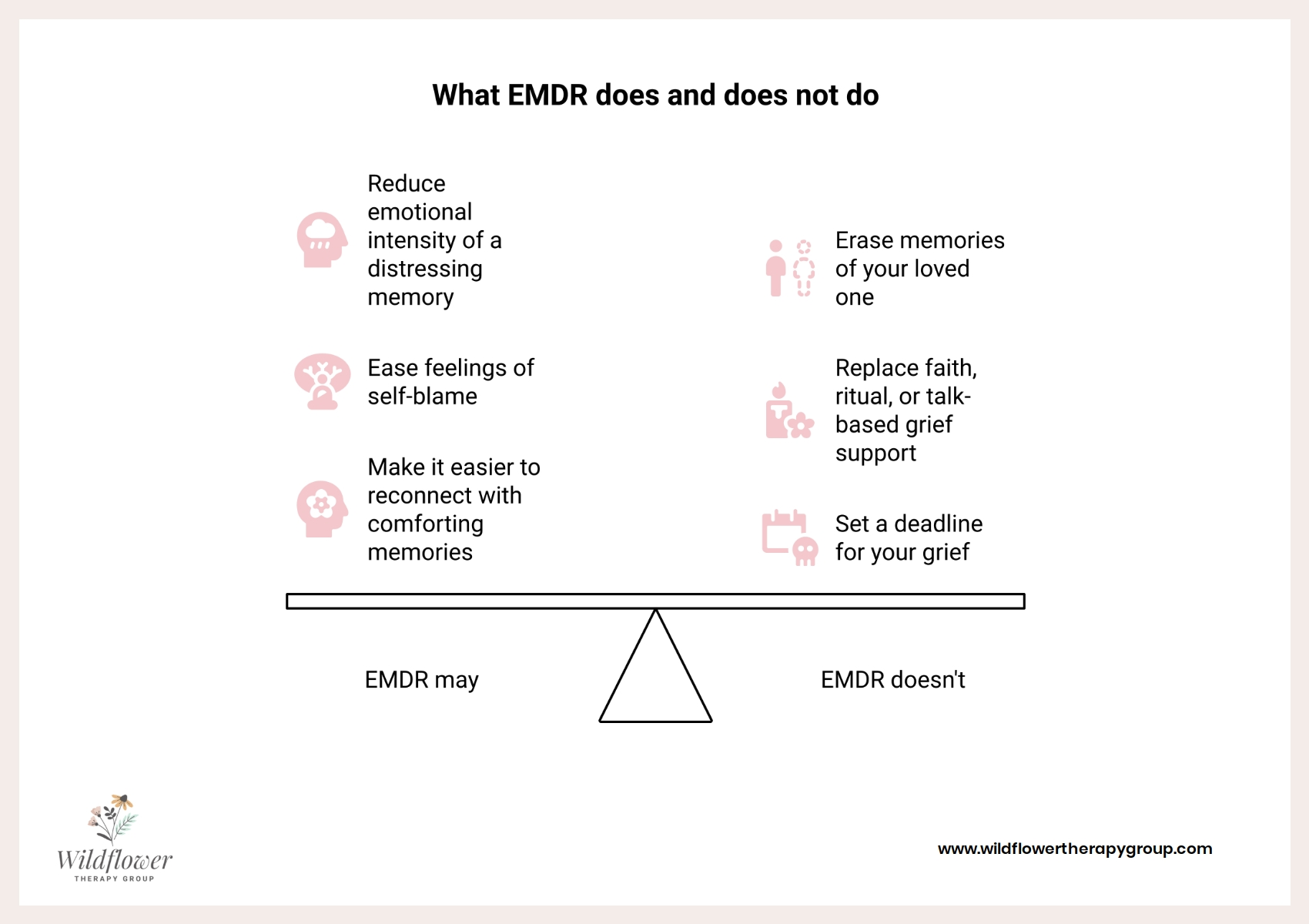
What EMDR Does and Does Not Do
EMDR may:
Reduce the emotional intensity of a distressing memory, such as a hospital room or a last conversation
Ease feelings of self-blame, like "I should have done more"
Make it easier to reconnect with comforting memories
Support a sense of loving someone even though they're gone
EMDR doesn't:
Erase memories of your loved one
Set a deadline for your grief
Replace faith, ritual, or talk-based grief support
Promise a particular result
EMDR Grief Work: Which Parts of Loss It Targets
EMDR typically focuses on specific distressing memories, reminders, and beliefs associated with a loss. Together, you and your EMDR therapist might choose:
The hardest scene, such as the last day or the moment of a phone call
Images that keep coming back when you don't want them
Present-day reminders, such as a smell, a holiday, or a ringing phone
Beliefs like "It was my fault" or "I can't survive this"
Earlier losses or traumatic memories that make this loss feel heavier
For example, someone who learned of a death through a late-night phone call may still tense up whenever the phone rings after dark. That single moment could be a possible starting point for treatment.
Is EMDR Good for Grief and Loss? What the Research Says
Research on EMDR and grief is encouraging, and it's still growing. A 2024 review on EMDR for prolonged grief describes EMDR as a fitting treatment option for prolonged grief. The approach addresses distressing memories, barriers to adapting to the loss, present-day triggers, and fears about the future. The same review notes that about 7 to 10% of bereaved people experience a more complicated and persistent form of grief.
Earlier research often used the term "complicated grief." Today, prolonged grief disorder is a recognized diagnosis in the DSM-5-TR, describing persistent, intense grief that causes significant distress or interferes with daily functioning. For adults, the diagnosis requires that at least a year has passed since the death, but you never need to wait a year to seek support. None of this is a label for your grief.
A systematic review of grief therapies looked at 30 randomized controlled trials published between 2011 and 2024. It found that combining CBT with mindfulness, exposure therapy, or EMDR showed promise, especially for trauma-related grief. Cognitive behavioral therapy (CBT) is a structured form of psychotherapy that addresses patterns of thinking, behavior, and emotional responses.
The EMDR International Association (EMDRIA) trains clinicians in this area. Its training material notes that three things can complicate a loss: traumatic circumstances such as a sudden or violent death, the separation distress of the loss itself, and unresolved past trauma and losses.
Although research on EMDR for grief is promising, its evidence base is more established for PTSD than for grief-specific conditions, and more research is needed on different types of loss. That is one reason we see EMDR as one part of care, alongside stabilization and grief-informed support.
EMDR for Grief and Loss That Is Traumatic or Layered
Trauma and grief often overlap after a sudden death, a long and difficult illness, or several losses close together. When that happens, the hardest memories may block the warmer ones. An EMDRIA resource on grief notes that "EMDR can help facilitate the assimilation of loss and movement through the mourning processes."
A new loss can also stir up older ones. When you're ready, EMDR can include those earlier memories too.
How a Grief-Focused EMDR Session Unfolds
EMDR follows eight phases, and you won't jump straight into the hardest memory. Here's how each phase might unfold when you're working with grief:
History and planning: You share your experiences without pressure to disclose every detail.
Preparation: You build grounding tools and a sense of safety. These tools can help you manage distress during treatment.
Assessment: You choose one target and notice the image, belief, emotions, and physical sensations that go with it. Your therapist assesses the distress tied to the memory.
Desensitization: Bilateral stimulation begins while you notice whatever comes up. Different emotions, thoughts, and sensations may arise.
Installation: You strengthen a kinder belief, such as "I did what I could."
Body scan: You notice any tension that's left. It may soften, or it may point to more work.
Closure: Your therapist helps you feel as grounded as possible before the session ends, even if the work isn't finished.
Reevaluation: At the next session, you review changes in your responses to the memory.
In some cases, if there is a single event/recent event trauma, there are other protocols that can be used, like a "recent event protocol."
Pacing, Grounding, and Taking Breaks
You can pause at any time, and a simple hand signal is enough to stop. Grounding and resourcing techniques used during EMDR preparation may include visualizing a calm place, practicing slow breathing, feeling your feet on the floor, or holding a familiar object. We work at your pace, and preparation can last as long as you need.
What You Might Feel After a Session
After an EMDR session, some people feel lighter. Others notice waves of sadness, a sense of emptiness, vivid dreams, or deep tiredness for a while afterward. Some people experience these reactions temporarily as they adjust after a session. If distress becomes intense, persists, or interferes with daily life, contact your therapist.
Gentle aftercare can help. You might drink water, rest, take a slow walk, journal, or spend quiet time in prayer or reflection. Tell your therapist what came up. If you're experiencing emotional distress or a mental health crisis in the United States, you can call or text the 988 Suicide & Crisis Lifeline at any time. If you're in immediate physical danger, call 911.
Can EMDR help with grief before a loss happens?
EMDR may help address distressing memories and fears associated with anticipatory grief, which occurs before an expected loss, such as when a loved one has a terminal illness. Research specifically examining EMDR for anticipatory grief is limited, so a therapist can help determine whether it is appropriate alongside other forms of emotional support.
Curious Whether EMDR Fits Your Loss?
You don't have to decide anything today. A free 15-minute consultation is a chance to ask questions, share as much or as little as you like, and see whether EMDR feels right for you. You can call us at (919) 524-3390.
Where EMDR Fits With Faith and Talk Therapy
You can use EMDR alongside faith, ritual, community, and talk therapy, not instead of them. Many people draw on more than one.
Talk-focused grief therapy: Focuses on your story, on meaning, and on adjusting to life after the loss. Sessions may involve discussing your loss, exploring its meaning, and developing ways to adapt to life afterward. It may suit you if you want space to talk and reflect.
EMDR: Focuses on specific stuck memories, triggers, and beliefs. It's structured, and preparation comes first. It may suit you if distressing memories associated with your loss remain overwhelming or if you prefer an approach that doesn't require detailed verbal recounting.
Combining them: Works with both meaning and stuck moments, and the pace shifts as your needs change. It may suit you if your loss is layered.
Honoring Your Beliefs and Meaning-Making
Your beliefs guide the work. EMDR doesn't ask you to change your faith or take on a new view of death. If prayer, scripture, or a sense of ongoing connection with your loved one matters to you, it can become a source of comfort during sessions.
Loss, Relationships, and Attachment
Grief is shaped by the bond you had. A loss can also stir up older relationship wounds, such as feeling unseen or left behind. Attachment-focused EMDR incorporates attention to early relationship experiences, attachment patterns, and unmet emotional needs alongside trauma processing.
EMDR for Pregnancy Loss and Loss of a Parent
Healing After Pregnancy Loss
Pregnancy loss is a real loss, whenever and however it happened. Others may not acknowledge it, and you may be grieving quietly. Memories of an ultrasound appointment, a medical procedure, or physical recovery may also bring up distressing emotions and bodily sensations. EMDR may help those memories feel less overwhelming while honoring your loss, your feelings, and the hopes you carried. You can read more about healing after pregnancy loss.
Losing a Parent or Loved One, Even Years Later
Grief doesn't follow a calendar. Picture a composite example: someone who lost a parent years ago feels a heaviness in her chest every spring. She has talked about it many times, yet the last hospital visit still feels close. For someone like her, EMDR may help that visit settle so warmer memories can come forward. Your grief deserves care, no matter how much time has passed.
Beyond Death: EMDR for Divorce, Pet Loss, Estrangement, and Other Losses
Not every loss involves a death. Grief can follow any significant ending. Sometimes it's disenfranchised grief, which means grief that others don't acknowledge or recognize. Your sorrow doesn't need anyone's permission.
Divorce or the end of a relationship: You may be grieving a shared future, your routines, and who you were in that relationship. Specific moments may keep replaying.
Pet loss: The bond was real, and this grief is often brushed aside. A last day or a decision at the vet may feel stuck.
Estrangement: Grieving someone who is still living can be confusing. There's often no ritual and no clear ending.
Empty nest or identity loss: When a role you built your days around changes, the quiet can feel like losing part of yourself.
Job loss: Losing a job can mean losing structure, purpose, and community. Sometimes the pain centers on one conversation.
When these experiences involve particularly distressing memories or persistent negative beliefs, EMDR may be considered as part of an individualized treatment plan. Research specifically examining EMDR for non-death losses remains limited.
Do I need to know which memory to start with?
No. You and your therapist can work it out together during planning, and you can change direction as you go.
What to Expect: Timeline, Formats, and Who May Want More Support First
Timelines vary. Some people focus on one stuck memory over a few sessions, while people with layered loss may work longer. Read more about what your EMDR timeline might look like.
Some people may benefit from more stabilization before processing. This may include people experiencing acute emotional distress, navigating an ongoing crisis, or coping with limited support. Recent bereavement alone does not make someone unsuitable for EMDR; readiness is assessed individually. Needing more time to prepare isn't a failure. It just means you spend more time in the preparation phase.
Finding Room for Grief Without Losing Your Connection
Grief doesn't have an endpoint or a deadline. It changes shape as you carry it. If distressing memories continue to overshadow other parts of your grief, EMDR may help reduce their emotional intensity without diminishing your connection to what you've lost. It moves at your pace and honors your story and your beliefs.
Wildflower Therapy Group offers EMDR and grief support at Wildflower in Raleigh, NC, both in person and online. Jaclyn Sappah, LCSW, C-IAYT, is an EMDRIA-certified therapist. When a loss feels stuck, the work starts with preparation and body-based grounding, moves at a pace you choose, and leaves room for faith and meaning. You can learn more about our EMDR therapy services in Raleigh.
Your next step is a free 15-minute consultation. Call (919) 524-3390 or email info@wildflowertherapygroup.com.